
“Where the real world changes into simple images, the simple images become real beings and effective motivations of hypnotic behavior.” -Guy Debord
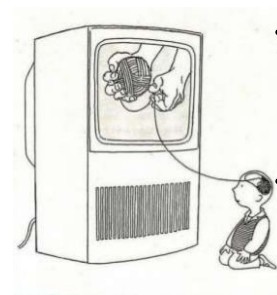
We lives in an age where television, mobile phones, social media are such common thing that they considered a part of the family. Sociologist and media theorist George Gerbner has rightly said “The longer we live with television, the more invisible it becomes”. The presence of these mediums are considered for granted and with the extended use of these services, we have started to believe in everything that these mediums feed to us without asking questions. Most of our social understanding are constructed by these mediums, so wouldn’t it be right to say that what we consider as reality should be rightly called ‘Mediated Reality’?
Mediated Reality is generally used as a technical term for describing reality which is a mix of virtual and real information. George Gerbner studied this mediated reality, and formed a theory called ‘Cultivation Theory’ which claimed that the reality that we perceive are greatly influenced by the media and news. According to his research, he described mediated reality as “stable, repetitive, pervasive and virtually inescapable pattern of images and ideologies” which is often wrong. He conducted a set of social experiments which concluded that the violence which is shown by media are over exaggerated and much more intense compared to the reality.We are surrounded by several mediums of information and with the story telling technique of these mediums and the constant repetition of facts, ideas or myths, we fall into believing them without reasoning, just like the concept of Religion.
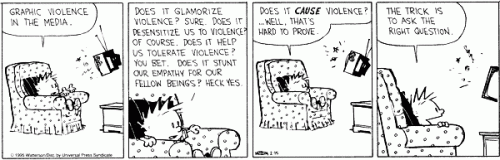
Today social media and politics go hand in hand, and people fall into the trap of forming orchestrated images of people in their minds without delving deep into reality. Social Media has changed the manner of political communication in such a drastic manner that any politically important person has become more accessible to the general audience. Joyojeet Pal describes Narendra Modi creating an image on social media and television which portrayed him as one having an “orchestrated erudition”. The media campaign for the Bharatiya Janta Party was so strong that the phrases “Abki Baar Modi Sarkaar” and “Ache Din aane wale hai” became the catchphrase for most people in the election time. People started to support the political parties without even questioning the policies and the ideologies that the party brought. They were just swayed by the slogans and the image that was created by the media which portrayed Manmohan Singh as a mute leader who was a prop controlled by a foreign person, Sonia Gandhi, and Modi on the other hand as a charismatic leader bringing the good days. Social Media was smartly used by Narendra Modi who while showcasing his works, spoke more about his political vision and the celebrated national icons like Swami Vivekananda, Veer Savarkar, Rani Lakshmi Bai and Sardar Patel. The repetitive and pervasive manner of his tweets and posts made Modi a household name, and people considered them more familiar with him than any other political leader.
The question is that is this a justifiable thing to do? Imagine knowing a person without even meeting him! However this second hand knowledge is questionable andcould create a tainted image of that person which may be seemingly good and has been created to suit to his needs. Similar is the work of advertisements. Most ofthe advertisements are placed in such a manner that makes the viewer feel that he is missing out on something. It alters the perception of the viewer such thatthey feel insecure and consider that the product is a part of everyone’s life and they should have it. Thus being successful in creating a mediated reality.
In today’s social era, the news media are broadly divided into two sources, the television and the internet. While the television doesn’t give enough options tothe user to select what he/she wants to watch, the internet has a wide range of options from which the user can choose whom or what he/she wants to follow orlearn about. However this selection too is greatly influenced by the ongoing trend which is set by the television or the environment in which the user is, and isgenerally referred to as ‘mainstreaming’. Thus we find that the user is generally feeded with data which is served by the news media as and how it wants to beportrayed and manifest the main basic features. The news have turned more dramatic and imparts information in a storytelling manner by recreating the events inthe form of animation or a movie so as to make the viewer hooked onto its channel. This dramatic twist creates a set of prejudices in the minds of the users andinduces emotions which might not have formed on their own. One of the latest examples of this is the war hysteria created by the television news media during thePulwama attack. A tragic incident was portrayed as a full fledged war between two countries and even peace loving people were provoked into wanting to takeviolent action against the other nation. Similar is the example of the prejudice of Muslims considered as a religious fanatic and terrorist, as portrayed by themedia. This has led to people being more Islamophobic, without even them ever having interacted with a Muslim person. This portrayal is done by the repetitive andpervasive manner of the media.
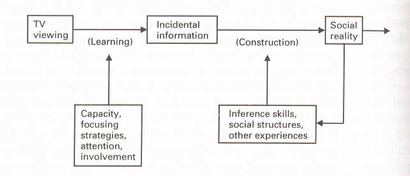
However the conceived reality differs from person to person and depends on the previous experiences and interaction the person had with the subject of the news.The mediated reality may not influence a person who has had personal experience with the subject and the “repetitive, pervasive and inescapable manner” will haveno effect on him/her. This is the shortcoming of the ‘Cultivation Theory’ which proposes that, like a plant is cultivated from its soil, a person is cultivated bycontext, in which media plays an important role. What we learn from this is that a person should weigh his lived experiences more than the reality which isimposed upon us from media sources.
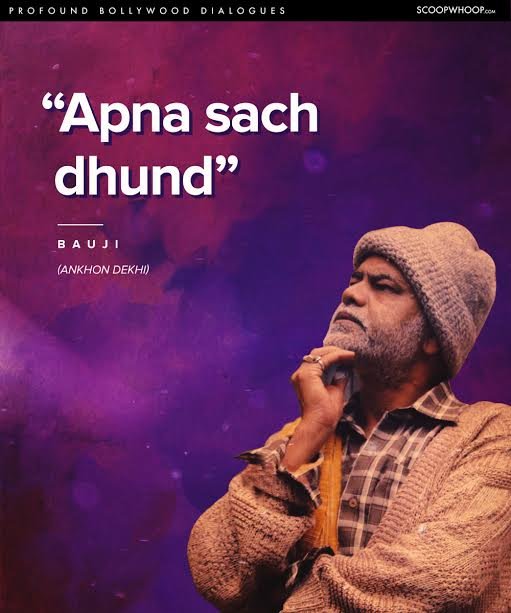
The very essence of this truth was clearly reflected in the film ‘Ankhon Dekhi’ where the central character Bauji after finding some reality twisted by the society, takes a firm resolution on believing only on what he sees and wisely says “Apna Sach Dhoond (Find your own reality)”.
References:
- daily.jstor.org/mediated-reality-no-match-personal-experience
- kafila.online/2015/01/30/NARENDRAMODI-OR-HOW-I-LEARNED-TO-STOP-WORRYING-AND-LOVE-THE-BRAND-JOYOJEET-PAL
- Living with Television: The Dynamics of the Cultivation Process - George Gerbner, Larry Gross, Michael Morgan, and Nanoy Signorielli
- web.asc.upenn.edu/gerbner/Asset.aspx?assetID=1644
- Ankhon Dekhi Movie -Rajat Kapoor
Sociology Term Paper
“Use the idea of news media stories and their consumption by an audience as ‘mediated reality’ by reading Dr Pal’s essay on Mr Narendra Modi’s twitter account.”
Loading comments...