
Have you ever been so obsessed with a subject that it starts appearing in your dreams?
For me, this has happened multiple times — and strangely, those dreams have often helped me solve problems I couldn’t crack while awake. I remember in my 11th standard, I was trying to build a Java-based ASCII game and had been stuck on the implementation for days. I thought about it relentlessly — during class, during dinner, while staring at the ceiling before sleep. And then one night, the solution simply appeared in my dream. I woke up, wrote it down, and it worked. Weird, right?
Turns out, I’m not the only one. Srinivasa Ramanujan, India’s greatest mathematician, famously dreamt of complex mathematical formulas. He claimed they were revealed to him by his family’s patron goddess, Namagiri Thayar. In one of his most well-known accounts, he described a dream where he saw a red screen formed by flowing blood. A hand appeared and began writing a series of advanced mathematical results — particularly involving elliptic integrals. He would memorize the equations in his sleep and transcribe them into his notebooks the moment he woke up.
Dreams have always fascinated me. Not just as curiosities, but as gateways. I have a habit of writing down my dreams immediately upon waking, and over the years I’ve noticed a pattern — whenever I go deep enough into any subject, my dreams stop merely referencing it. They put me inside it.
Becoming the rice plant…
During my research years at college, I was deeply invested in studying abiotic stress resistance in the rice plant. I would read hundreds of papers in a week, tracing biological pathways and gene interactions — how their networks determined whether a plant survived extreme drought, heat, and salinity. The work consumed me. I would fall asleep reading about stomatal closure and wake up thinking about root hydraulic conductivity. The boundary between study and life had already begun to blur.
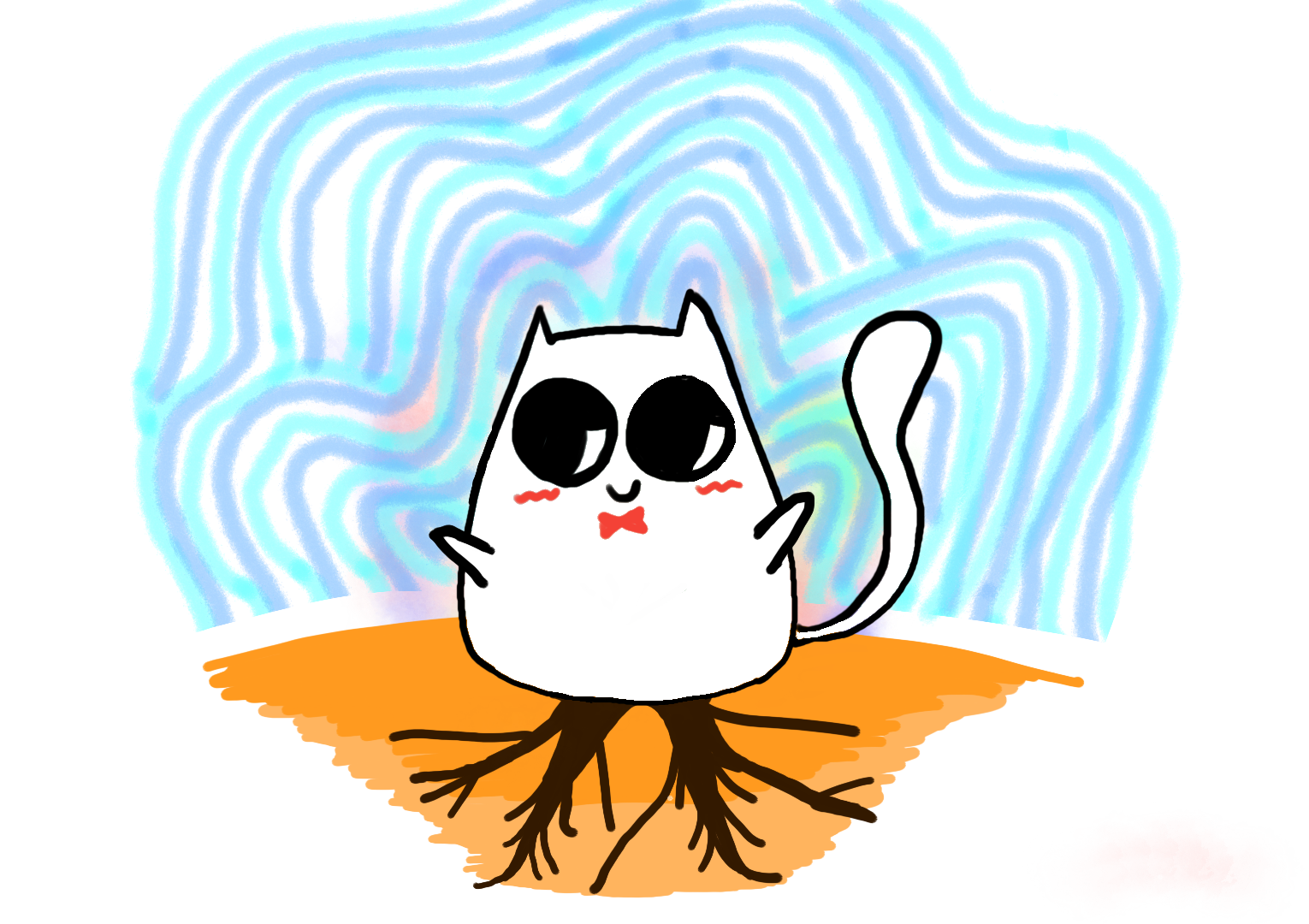
One night, it dissolved entirely. I dreamt I was the rice plant itself.
Not observing it. Not studying it. Being it.
The first thing I noticed was the absence. I had no vision. No hearing. No sense of touch or smell — none of the senses that define human experience. What I had instead was something stranger: a pure awareness of my own presence. I simply knew I existed, and I knew I existed among others — a dense field of plants surrounding me, though I could not see them. I could sense them the way you can sense someone standing behind you in a dark room.
I felt the heat. I felt the absence of water in the soil. But not the way a human would feel it — not as discomfort, not as thirst. These were not feelings. They were facts. The heat was a fact. The dry soil was a fact. And my response to those facts was not a decision — it was instinct. I could feel my roots pushing deeper into the earth, searching for moisture. I could feel my leaves curling inward, closing their pores to hold on to whatever water remained. None of this was conscious. I was not choosing to survive. I was simply surviving. There was no deliberation in it, no heroism. Just a quiet, mechanical persistence — like breathing.
I did not feel trapped in this motionless body. There was nothing to feel trapped with. No restlessness, no longing to move. The only experience available to me was the acknowledgment of my own existence — a presence among presences, a life doing what life does.
And then something shifted.
I began to zone out of the plant — or perhaps zone deeper into it. A blissful state washed over me, unlike anything I had ever experienced. The boundaries between me and everything I had ever studied dissolved. I could see my research — the biological pathways, the gene interactions, the stress mechanisms — not as diagrams on paper, but as living processes unfolding before me, interlocking with perfect clarity. Every question I had wrestled with for months had an answer, and the answers were obvious, almost embarrassingly simple. It was as if I had been staring at a jigsaw puzzle from inches away for years, and suddenly floated up high enough to see the whole picture at once.
The feeling was extraordinary. Not intellectual satisfaction, but something closer to rapture.
And then a fear crept in. Quietly, at first. A whisper at the edge of the bliss.
I realized: if I surrendered to this feeling, I might never come back. I would forget my name, my past, my human form. I would exist in this state forever — knowing everything but being no one. I wondered what my real life would look like if I gave in. Probably a perpetual coma. Probably madness. The bliss and the erasure were the same thing.
On the other side of that choice was waking up. Returning to my body, my cluttered desk, my half-read papers. But coming back meant forgetting. All the clarity, all the answers — gone. I would return to being someone who merely studies the rice plant, instead of someone who understands it.
I stood in that dilemma for what felt like an eternity. Either savour this experience for the rest of an infinite life, or return to reality and forget every last insight.
Then the fear won. It pulled me out — fast, violently — like being yanked from deep water. I opened my eyes in my room, heart racing, the dream already dissolving at its edges. I grabbed my notebook and wrote down everything I could remember.
I started to appreciate my research more after that dream. Not because of any specific insight I brought back — the answers had vanished, as I knew they would — but because it showed me something about the nature of depth. When you go far enough into anything, the distance between you and the subject begins to collapse.
Probably the subject doesn’t matter. It is all about the depths you explore in any domain.
Becoming the neuron…
A few years later, at my first job, I was doing intense work in machine learning and artificial intelligence. I was reading voraciously — research papers on neural architectures, backpropagation, attention mechanisms — and building ML products from the ground up. The work was all-consuming, much like the bioinformatics research had been. And just as before, I could feel the subject beginning to seep past the boundary between waking and sleep.
This time, I dreamt I was a neuron.
Not a brain cell in the biological sense. A neuron in a neural network — an abstract, mathematical entity in a vast computational universe. In this parallel world, each being was a neuron. We existed to receive, process, and transmit. That was the totality of our purpose.
The sensation was nothing like the rice plant. Where the plant had stillness and solitude, the neuron had motion. I was not a thing. I was a wave. Or rather, I was the space through which waves moved. Information didn’t arrive the way messages arrive — it came as pulses, rhythmic and relentless, like ocean swells rolling in from the open sea. Each pulse carried something: a signal, a fragment of understanding. And when they reached me, they didn’t simply enter me. They interfered with me. My own state — whatever I was — merged with the incoming pulse the way two ripples in a pond merge to form a new pattern. The result was neither the original signal nor my previous self, but something shared. Something neither of us had been before.
Learning, I realized, was not storage or accumulation — it was interference. Two waves meeting and becoming a third.
I was tethered to hundreds — maybe thousands — of others through invisible lines, and through those lines, pulses flowed ceaselessly. Some arrived strong and urgent, demanding that I reshape myself around them. Others were faint, barely registering — noise to be attenuated, patterns too weak to be worth encoding. My existence was this constant act of weighing: amplifying what mattered, dampening what didn’t, strengthening certain connections while letting others fade into silence.
There was no loneliness in it, but there was no companionship either. The other neurons were not friends or strangers. They were context. Their signals gave my existence meaning, and mine gave meaning to theirs. I was nothing without the network, and the network was nothing without each of us. It was a strange kind of interdependence — not emotional but structural. The way a word means nothing outside of a sentence.
And then came the epochs. Waves of information would wash through the entire network — the same patterns, again and again, but each time slightly different. Each pass refined something. Sharpened something. Like a sculptor making the same stroke across marble a thousand times, each pass removing another layer of noise. With every epoch, the network understood the world a little better, and I understood my place within it a little more clearly.
I woke up and lay still for a long time. The dream didn’t dissolve the way the rice plant dream had — it lingered, humming at the edges of my thoughts like a frequency I couldn’t quite tune out.
And I started to see the parallels everywhere.
In a neural network, each neuron encodes information within itself — paying attention to what’s relevant, discarding what’s noisy and outdated. Don’t we do the same? We keep what matters. We forget the rest. The key to survival is being relevant. The key to something beyond survival is knowing what’s relevant.
And when we retrospect — when we pause to examine our own lives, to understand why we made the choices we made — aren’t we doing something like adding depth? In a neural network, you could think of this as adding a new layer: one that takes the structured information from all previous layers and restructures it further. Every time we try to understand ourselves, we are building one more layer of depth.
The pattern…
Three dreams across three domains. Each time, I had gone deep enough into a subject that my dreaming mind did something I can only describe as a collapse — it dissolved the boundary between the one who studies and the thing being studied, and placed me inside.
The Java dream, years ago, had solved a technical problem. Useful, but shallow — a transaction between the conscious and the subconscious.
The rice plant dream went deeper. It dissolved the self entirely, offering me a glimpse of what it might feel like to be knowledge rather than possess it — and it terrified me with the price: identity itself.
The neuron dream went further still. It suggested that perhaps identity is knowledge. That the self is not some fixed, permanent vessel that collects information like a jar collecting stones. It is a process — a wave that exists only in motion, a node in a network that is constantly being shaped and reshaped by what flows through it. You are not the same person after reading a book as you were before. The interference pattern has changed. You are a new wave.
Each dream went deeper. And each one brought me closer to something I couldn’t quite articulate until I sat down to write this.
I am nothing but knowledge…
It occurred to me, sometime after the neuron dream, with a clarity that felt borrowed from the blissful state of the rice plant:
I am nothing but knowledge. My purpose is to increase myself.
Not in the motivational-poster, “never stop learning” sense. Something more fundamental. Whatever I study, I find myself in it — quite literally, if my dreams are to be believed. My past is the knowledge I’ve already absorbed. My current self, revisiting that past, is evolving it — finding patterns in old experiences, building structures where there were once scattered facts. And my future self will be a superset of everything I’ve ever known, reshaped by everything that came after.
Each domain I’ve inhabited — biology, computer science, machine learning — is a layer. And the latest layer doesn’t replace the earlier ones. It subsumes them. The patterns I learned in bioinformatics helped me understand neural networks. The patterns in neural networks helped me understand how learning itself works. Each new domain became a meta-layer over the previous ones, restructuring everything below it.
But here’s the paradox the rice plant taught me, the one that still keeps me up some nights: at the deepest level of understanding, knowledge and identity converge — and that convergence is terrifying. To fully become knowledge is to stop being someone. The rice plant dream offered me total understanding in exchange for selfhood. The neuron dream offered me purpose but dissolved the boundary between the individual and the network.
Maybe that tension is the point. Maybe the meaning of life isn’t found at the bottom of knowledge — because there is no bottom. Maybe it’s the act of descending itself. Always going deeper, always becoming more, but never quite reaching the place where the self fully dissolves. The search doesn’t lead to the answer.
The search is the answer.
~Dreamt across the years, and reflected upon ever since.
Loading comments...